Denver Judge: City Park Flood Plan May Be “Thinly Veiled Subterfuge” to Widen I-70

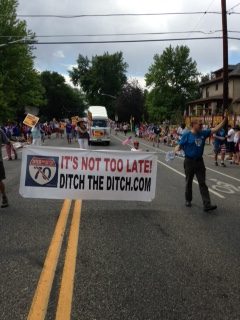
A parade with people marching down the street.


While the judge decided not to halt the drainage project, his decision could lend momentum to a federal lawsuit against the highway expansion through north Denver neighborhoods.

By David Sachs

Streets Blog Oct 27 2017

ORIGINAL ARTICLE HERE

Denver District Court Judge David H. Goldberg won’t stop a flood control project at City Park Golf Course tied to the widening of I-70 through minority, low-income neighborhoods in north Denver. But he did say the drainage work “may be a thinly veiled subterfuge†to grease the skids for the highway expansion, which could prove relevant in a separate federal case against the I-70 project.

Plaintiffs suing the City and County of Denver argued that the true purpose of the project — which is absent from the city’s 2014 Storm Drainage Master Plan — is to protect the Colorado Department of Transportation’s I-70 expansion, which promises to increase traffic and pollution for years to come.

The $1.8 billion I-70 project would sink a portion of the highway 30 to 40 feet below ground, creating a flood pocket during large storms. Having the city assume the burden of drainage infrastructure shifts costs from CDOT and private companies to Denver taxpayers who pay a stormwater fee, advocates argued.

[dropshadowbox align=”none” effect=”lifted-both” width=”auto” height=”” background_color=”#fae7e6″ border_width=”1″ border_color=”#dddddd” inside_shadow=”false” outside_shadow=”false” ]As a city district judge, Goldberg can only rule on whether the drainage project violates the city charter. “Though the reconfiguration of CPGC may be a thinly veiled subterfuge to pave the way for new construction plans on I-70 and along the I-70 corridor, consideration of the various rationales and funding mechanisms for the Project is beyond the scope of this Court’s charge,†Goldberg wrote in his decision [PDF].[/dropshadowbox]


The pending case against the highway widening in federal court won’t be bound by such narrow legal concerns, however. That suit argues the Federal Highway Administration should not have approved CDOT’s widening without including the flood project in its environmental analysis.

[dropshadowbox align=”none” effect=”lifted-both” width=”auto” height=”” background_color=”#fae7e6″ border_width=”1″ border_color=”#dddddd” inside_shadow=”false” outside_shadow=”false” ]Plaintiff’s attorney Aaron Goldhamer said there’s a silver lining to the legal defeat. “The judge in the federal court may very well read [Goldberg’s ruling] as a guiding statement as to what the evidence in this case did show,†Goldhamer said. “I’m much more optimistic about the federal case. I think there are some very strong claims there and this ruling may only bolster those claims.†Goldhamer pointed to the judge’s acknowledgment of “subterfuge†and evidence that the flood project will have adverse environmental impacts. The City Park Golf Course project will remove 263 trees and change the grading of the land. Goldberg wrote that “the loss of a mature [tree] canopy is materially detrimental to the habitat and the neighborhood†an could “take decades to redevelop.â€[/dropshadowbox][dropshadowbox align=”none” effect=”lifted-both” width=”auto” height=”” background_color=”#fae7e6″ border_width=”1″ border_color=”#dddddd” inside_shadow=”false” outside_shadow=”false” ]Plaintiff’s attorney Aaron Goldhamer said there’s a silver lining to the legal defeat. “The judge in the federal court may very well read [Goldberg’s ruling] as a guiding statement as to what the evidence in this case did show,†Goldhamer said. “I’m much more optimistic about the federal case. I think there are some very strong claims there and this ruling may only bolster those claims.†Goldhamer pointed to the judge’s acknowledgment of “subterfuge†and evidence that the flood project will have adverse environmental impacts. The City Park Golf Course project will remove 263 trees and change the grading of the land. Goldberg wrote that “the loss of a mature [tree] canopy is materially detrimental to the habitat and the neighborhood†an could “take decades to redevelop.â€[/dropshadowbox]


which may result in significant detrimental chemical and biological changes to the soil and golf course that could take up to 10 years to manifest,†according to arborist Rebecca Wegner, who testified for the plaintiffs.

Goldhamer filed an injunction last month to stop CDOT from beginning construction before the federal case is heard. The request is still pending.

If a federal judge orders CDOT to redo its environmental analysis to include the drainage infrastructure, that would stall the widening, Goldhamer said, likely beyond next year’s election of a new governor. The question of whether to stop the expansion would then fall to whomever Coloradans elect to replace John Hickenlooper in 2018.

District Court Decision on City Park Golf Course (CPGC)

A lake with trees in the background and a grassy area.


CITY PARK FRIENDS AND NEIGHBORS FOR IMMEDIATE RELEASE A green sign with the words join cpfa
For more information, please contact:
LaMone Noles
President, City Park Friends and Neighbors
720 988-4433
President@CPFAN.org
https://dev.cpfan.org
Twitter: @cpfan_dnver

Face Book:https://www.facebook.com/CityParkFAN/

District Court Decision on City Park Golf Course (CPGC)

Thursday, October 26– Today’s Ruling in MacFarlane vs. City & County of Denver, issued on very
narrow legal grounds, was a loss for thousands of parks advocates and their efforts over recent years to preserve existing Denver parks, increase the amount of park acreage per resident, and limit the discretion of the Director to alter a park’s purpose.

This ruling, however, will not slow the efforts of City Park Friends and Neighbors (CPFAN) and of park advocates throughout Denver in the quest to preserve and strengthen Denver’s park system as a whole, and hold appointed and elected leaders accountable for their actions.

More actions to save CPGC will be announced soon.

Today’s ruling followed a four-day trial to the Court, in August 2017, in which Plaintiffs claimed that Denver’s
proposed taking of CPGC for a flood diversion facility violated Denver’s Zoning Code, Denver’s Charter, and Colorado common law.

Plaintiffs’ attorney Aaron Goldhamer expressed his disappointment in the result.  “While Judge Goldberg found that—in fact—the proposed project will result in a ‘materially detrimental’ effect on the natural habitat and neighborhood due to the loss of mature trees, and that the large scale regrading of the course may result ‘in detrimental changes to the health of the soil and remaining trees,’ he found that the existing law compelled his deference to the decision of Denver’s Department of Parks and Recreation to proceed with the project,†Goldhamer said.  “The Judge also acknowledged the ‘significant detriment’ to Denver residents should the course lose its historic designations, which he acknowledged is a real possibility.  Judge Goldberg noted he was ‘loath’ to see the course close, but that his hands were tied under existing law to defer to our elected officials and their appointees.  To ensure that Denver’s parks are protected in the future, we may need new laws or new elected officials.â€

The case involved Denver’s taking of the 138-acre CPGC for a regional 100 year flood storm water detention facility designed to support the expansion and lowering of I-70 through north Denver. The detention project calls for closing CPGC entirely for up to two years, the loss of approximately 300 trees and the wildlife habitat they provide, the loss of protected views, existing topography and sense of vastness, excavating and completely reconstructing the entire course, razing Bogey’s Club House built in 2001, and changing the foundational layout and design of the course.

This treatment of CPGC runs counter to Denver’s 2001 City Park Master Plan, “Revitalizing the Legacy of City Park†by Mundus Bishop which calls for the preservation of the golf course in its present state.

The project will cause the green benefits provided by the current landscape to be lost. The project’s disregard for the Olmsted and Bendelow design makes it likely that CPGC will lose its designation on the National Register of Historic Places. In addition, dangerous, toxic storm water is being designed to run through the course in open channels.

CPFAN wants to extend a heartfelt thank you to plaintiffs’ attorneys Aaron Goldhamer and Tony Vaida for their countless hours working on this case. CPFAN also wishes to thank the community for their heartfelt support.

[dropshadowbox align=”none” effect=”raised” width=”auto” height=”” background_color=”#faeced” border_width=”1″ border_color=”#dddddd” rounded_corners=”false” inside_shadow=”false” outside_shadow=”false” ]DOWNLOAD OF DOCUMENT AVAILABLE HERE[/dropshadowbox]

[pdf-embedder url=”https://dev.cpfan.org/wp-content/uploads/2017/10/Order-Re-Findings-of-Facts-and-Conclusions-of-Law.pdf” title=”Order Re- Findings of Facts and Conclusions of Law”]


1 30 31 32 33 34 47