CITY PARK FRIENDS & NEIGHBORS NATURE PLAY COMMUNITY OPEN HOUSE

A bird 's eye view of the park and its surroundings.


City Park Friends & Neighbors is co-hosting a Zoom Community Open House event with the Denver Museum of Nature & Science (DMNS) and Denver Parks & Recreation (DPR) to discuss the creation of new natural play experiences in City Park.

This event will take place via Zoom on Tuesday, Feb. 2, 2021 from 6-7:30 PM.  Register to attend the meeting by filling out this form. A link to join the meeting via Zoom will be emailed to all registered attendees prior to the event.

We look forward to connecting and answering your questions and receiving your ideas about this project. To learn more about the project prior to the Community Open House, please visit www.dmns.org/natureplay.

MORE ABOUT NEARBY NATURE IN CITY PARK
After conducting a state-wide listening tour starting in 2012 to learn what Coloradans value most about their state and also their DMNS experience, DMNS came away with a new commitment to empower the voices of the community. “We strive to be a museum for the people, by the people,” says Jacqueline Altreuter, Director of Volunteers and Project Lead for DMNS’ Nearby Nature initiative. “We don’t want to impose our organizational will and desires onto the community but rather we want to elevate the voices of the community and act as a partner in realizing the community’s desires. After all, we can’t realize the Museum’s vision of an empowered community that loves, understands, and protects our natural world if we’re not actually empowering people and are instead just wielding our power as an organization. We want to be the catalyst, not the driver.”

One of the main community desires DMNS staffers heard was for more experiences outside the doors of DMNS in City Park. “They told us that time spent in nature was rejuvenating and that their experiences in nature were often a bridge to exploring and understanding science,” Altreuter continues. This feedback coincided with the recommendations in the 2018 City Park Master Plan Update for natural play experiences in the areas near DMNS.

Based on all the robust feedback they collected for creating nature experiences right outside their doors, DMNS entered into a partnership with DPR in 2019 to pursue the Nearby Nature initiative.

Nearby Nature is the umbrella for several projects – not only the Nature Play and the DeBoer Waterway projects but other possible projects as well. These other projects include the “greening-up” of the Boettcher Plaza on the south side of DMNS and creating more access and permeability at DMNS’s west and south entrances.

The Nature Play playground would roughly extend from the DeBoer Canyon outside the west DMNS entrance, west to the small playground bordering Ferril Lake and south to the 1925 Lily Pond (current home to the Color Field art installation). The DeBoer Waterway project reflects an often-repeated community desire (especially among kids!) for water in this area of the park. The DMNS and DPR team has met with “architects, hydrologists, ecologists, engineers and nature play experts to help us realize this vision,” according to Altreuter. DMNS and DPR hired a design team in September and have begun work on figuring out the infrastructure requirements to bring the community-inspired Nature Play and DeBoer Waterway projects to life.

Now DMNS and DPR are ready and eager for more community input about the current concepts that have been developed. The team is launching a massive new outreach effort with community meetings, mailings, and even offers of kits for interested community members to submit their own designs. DMNS and DPR want to receive as much feedback as possible about the current conceptual design of the Nearby Nature spaces.

Please join us on Tuesday, Feb. 2 from 6-7:30 pm for a Zoom Open House (see registration link above) to hear about the exciting new Nearby Nature projects. There will be a slideshow and there will be plenty of time for your questions and insights. We want to hear from you!!!

City Park Resolutions for 2021; Richard E. Sopris, the “Father of City Park”


JOIN US ON JAN. 5 TO BRAINSTORM IDEAS FOR SUPPORTING AND ENHANCING CITY PARK IN 2021!

Please join us for a Zoom Program on Tuesday, Jan. 5 at 6 pm. to share your ideas about City Park’s future. What would you like to see happen and continue to happen in the park in 2021? Pursuing volunteer opportunities like preparing and planting beds, adopting flower beds for specific attention, exploring the prospect of fewer cars in the parks, collaborating with East High School students on horticultural projects and rotating art installations are some of the ideas we have heard so far. We are sure you may have more ideas to share and we look forward to hearing them!

You are invited to a Zoom meeting.
When: Jan 5, 2021 06:00 PM Mountain Time (US and Canada)

Register in advance for this meeting:
https://zoom.us/meeting/register/tJAqf-yvpj8uG9J46vd0F35eum4iyJda_zNy ;

After registering, you will receive a confirmation email containing information about joining the meeting.

RICHARD E. SOPRIS: “THE FATHER OF CITY PARK”
Among the many adventurers and rugged pioneers who ventured to the gold fields of Colorado in the mid-1800s, Richard Sopris stood out. Hailing from Pennsylvania, Ohio and Indiana, he had already had successful careers as a steamboat captain on the Ohio River, a railroad contractor, and a diver for sunken treasures. When his iron foundry failed, he left his family in Indiana and set off for the West in a horse-drawn wagon with several compatriots, arriving in Denver in 1859. He began mining in Mountain City, between Central City and Black Hawk, and was moderately successful in these early ventures, but better known for his administrative abilities in these often wild, contentious and sometimes violent settings.
Courtesy of Western History Department, Denver Public Library
Returning to Denver, Sopris’ political abilities continued to be recognized and he was elected to represent Arapahoe County, Kansas Territory (as Colorado was then designated). He played a large part in ensuring that the territory he represented become its own state of Colorado instead a part of Kansas as many in Kansas Territory favored.

Next, Sopris joined an exploratory group heading farther west to pursue the quest for gold. He became Captain of the group that travelled as far as Utah. When stopping in present-day Glenwood Springs, Sopris and his crew were taken with the beauty of the area. Since Captain Sopris was the first of the small group to sight the mountain that presides over the valley, it was duly named Mount Sopris in his honor. Although no significant deposits of gold were discovered, Sopris’ group made maps of the areas they travelled through and notes on the plants and geography they observed. These records proved valuable to future travelers and explorers.

Courtesy of the Western History Department of the Denver Public Library

Returning to Denver, Sopris took up his gift for governance again, becoming a well-regarded sheriff in the rough and tumble town of the 1860’s. Because the Civil War was raging at the time, he joined the military and once again became a Captain of Company C, First Colorado Infantry that won the Battle of Glorieta Pass, a crucial victory for the Union effort. Retiring from the army in 1862, he returned to Denver and re-entered the political life for which he was so well suited. After serving in various offices, Sopris was handily elected the 15th Mayor of Denver in 1878. Aside from handling the many basic problems of a frontier city, like creating a sewage system to address the problems of trash and resulting typhoid fever, Sopris revealed his unprejudiced Western values in November,1880 when a riot broke out directed against Chinese citizens. Sopris directed all resources to quelling the riot and bringing  about not only law and order but a respect for all the citizens of Denver, wherever they were born.
The next phase of the energetic Richard Sopris’ career, and perhaps his most cherished, began in 1881 when he was appointed Denver’s first Park Commissioner. The idea of public land set aside for the public to enjoy first surfaced in the U.S. with the establishment of Central Park in 1858. It was only twenty years later, in 1878, that the Sopris and Lee park plan for Denver was articulated. This far-sighted plan envisioned a city with parks connected by tree-lined parkways and boulevards. City Park would anchor the system to the east and Sloan’s Lake to the west. As legislators wrestled with how their young city’s monies would be best spent, City Park, out in the prairie with mostly rattlesnakes and cottonwoods for company, was chosen as the first major park to be developed in Denver. Sopris’ support was critical in securing the funding for the new park east of Denver. Denver taxpayers paid $56,000 for the pioneer city to purchase the land. This would be about $1.2 million in 2021 dollars.
Sopris threw himself into plans to create a public space equal to if not surpassing NYC’s Central Park. The fact that 320 acres were set aside for City Park, the equivalent of approximately 1/2 of Central Park’s acreage, speaks volumes to Sopris and his supporters’ vision for Denver. It It is after all, Sopris who called Denver “The Queen City of the Plains” – a beautiful haven welcome to all.
                                  Courtesy of Western History Department, Denver Public Library

As he faced the arid and unforgiving soil of City Park, Sopris turned to engineer, Henry Meryweather to complete a survey of the park. The resulting design, according to Denver’s City Park,  by Bette Peters, “was typical of the era: pastoral, picturesque, naturalistic and democratic. The design allowed for the flow of horses and foot traffic through the park, future installation of formal gardens, statues, fountains, and other park amenities similar to those already established in Central Park or published in the Olmsted/ plans submitted to the New York City Council.” Sopris and his team were clearly influenced by Olmsted and his view of what city parks dedicated to the public should become. Sopris was so committed to the beautification of City Park that he poured his own money into improvements.

                                       Courtesy of the Western History Department, Denver Public Library

The tasks of transforming City Park into an oasis in the city were daunting. Weeds were everywhere. A sharecropper was ceded forty acres of parkland to grow oats in which the city would share the profits. The tents and shelters of transient settlers lined dusty York Street, slowing the process of developing a park until appropriate housing could be arranged for. Selecting trees that would thrive in the alkaline soil was another problem. Sopris studied varieties he believed would work, but to start the tree planting process he bought rows of native cottonwoods out of his own pocket and hired a gardener who lived in the park to shelter the new plantings from the cattle and wild animal roaming the land. To compensate for lack of water, Sopris established an artesian well on “museum hill,” the highest part of the park where the Museum of Nature and Science stands today.

Sopris retired as Park Commissioner in 1891, having served through the critical first ten years of City Park’s development. He left behind the beginnings of a dream that emerged into the reality we enjoy today.

Sopris’ son, Simpson T. Sopris memorialized his father’s influence on City Park with two structures. The Sopris Gateway at Fillmore and Seventeenth Avenue was originally a trolley stop but today serves as a pedestrian entrance into the park. It was built by architect Frank Edbrooke in 1911-12 out of red sandstone quarried from Colorado Springs. The Sopris Statue and Fountain, standing to the west of the Pavilion was another gift to City Park by Simpson Sopris. It was probably erected in 1920 and is in honor of his mother, Elizabeth Allen Sopris, The sculptor is unknown. The bronze statue of a little boy looking down towards his hands was originally holding a gnomon rod, a device that casts a shadow pointing at Polaris, within one degree of the north celestial pole. There used to be a pool below the statue.

Walk by the Sopris Gateway and read the inscription left there by Sopris’ son. It is a fitting description of the “Father of City Park,” a Denver pioneer to be reckoned with and revered.

Photo by Barbara Berryman
North American Flicker in City Park


GIVE US YOUR FEEDBACK

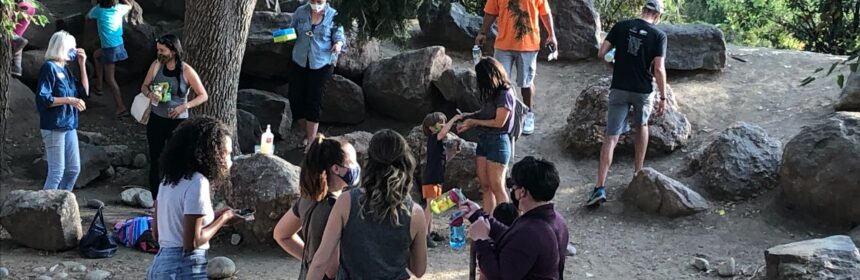
A group of people standing around in the dirt.


DESIGNS FOR “NEARBY NATURE” PLAY SPACES IN CITY PARK AT CPFAN’s DECEMBER 1 PROGRAM

Please joins us for a Zoom Program on Tuesday, December 1 at 6 pm. Jacqueline Altreuter, Director of Volunteer Engagement at the Denver Museum of Nature and Science, will present three possible new designs for the Museum’s “Nearby Nature” project and is eager to get the public’s reaction and ideas. “Nearby Nature” is a concept for a nature-based children’s play space extending from the DeBoer Canyon (south of the museum’s west entrance) to the small South Playground below. According to the Museum that is partnering with the Denver Department of Parks and Recreation on the project: “The ultimate goal of the nature play spaces is to inspire curiosity  and a love of the outdoor environment, planting the idea that protecting and caring for it is something we can all do together.”

BRING YOUR IDEAS ABOUT WHAT YOU WANT TO SEE IN CITY PARK
After the “Nearby Nature” review, join us to brainstorm about the community’s vision for the future of City Park. What are your concerns, your ideas, your wishes as the “Peoples’ Park” enters a new decade in its evolution. CPFAN Vice President, Sandy Robnett will present the Programs and chair the Board Meeting to follow. Please join us for new CPFAN Board member, Kelly Crosby’s report on a possible program linking East High (and other high school) students to creating short-term art installations in City Park.

Register for the December 1 CPFAN Program and Meeting below:
Hi there,

You are invited to a Zoom meeting.
When: Dec 1, 2020 06:00 PM Mountain Time (US and Canada)

Register in advance for this meeting:
https://zoom.us/meeting/register/tJIrdu2orzIuGNLBkTrYq3Bf9GHUuo53NWHW ;

After registering, you will receive a confirmation email containing information about joining the meeting.

1 9 10 11 12 13 48